
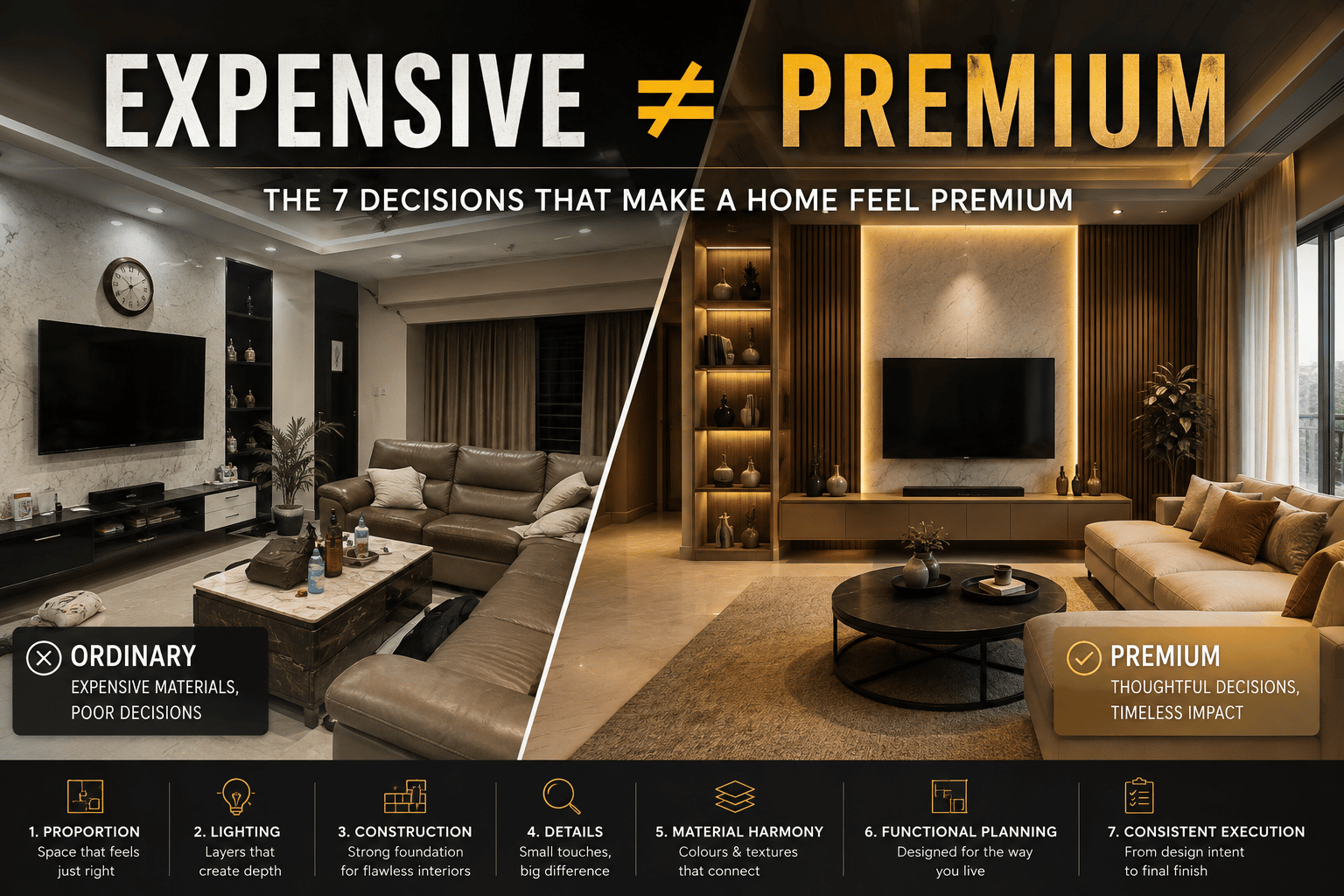
Why Expensive Interiors Still Look Ordinary: The 7 Decisions That Make a Home Feel Premium
A home can have expensive marble, premium furniture, designer lighting and custom-made wardrobes—and still not feel luxurious.
At the same time, another home with a more controlled budget can feel sophisticated, spacious and beautifully finished.
So what makes the difference?
It is rarely the price of an individual product.
The difference is usually found in proportion, planning, detailing, lighting and execution.
At Mistry Bhejo, we believe this is one of the most important things homeowners should understand before starting an interior or construction project:
A premium home is not created by buying premium products. It is created by making hundreds of decisions work together.
And those decisions begin long before the furniture arrives.
1. Start With Proportion, Not Products
One of the biggest mistakes homeowners make is choosing materials before understanding the space.
A beautiful marble, expensive sofa or designer light cannot compensate for poor proportions.
For example:
An oversized sofa can make a living room feel cramped.
An excessively deep TV unit can reduce usable space.
A false ceiling that is too low can make a room feel smaller.
Oversized tiles can look awkward in a compact bathroom.
A wardrobe that is too visually heavy can dominate a bedroom.
The better approach
Before selecting finishes, understand:
Room dimensions → furniture scale → circulation → storage → lighting → finishes
Every major element should relate to the size and purpose of the room.
The goal is not to fill the available space.
The goal is to make the space feel balanced.
2. Lighting Should Be Designed Before the Interior Is Built
Lighting is often treated as a finishing decision.
That is a mistake.
The lighting plan can influence the ceiling design, electrical layout, furniture positioning and even the atmosphere of the room.
A well-designed space usually combines different types of lighting:
Ambient lighting
Provides overall illumination.
Task lighting
Supports activities such as reading, cooking or working.
Accent lighting
Highlights artwork, textures, architectural features or décor.
Decorative lighting
Adds character and visual identity.
When these layers work together, the room develops depth.
When a room depends entirely on a few bright ceiling lights, even expensive interiors can feel flat.
Premium lighting is not about having more lights. It is about knowing where light should exist—and where it shouldn't.
3. Civil Work Creates the Foundation for Good Interiors
This is where interior design and construction become inseparable.
Before a wardrobe is installed, the wall needs to be properly prepared.
Before a kitchen is installed, plumbing and electrical points need to be correctly positioned.
Before a false ceiling is completed, lighting, electrical and air-conditioning requirements need to be coordinated.
Before premium flooring is laid, floor levels and surface preparation need to be right.
This creates a simple relationship:
Better construction planning → Better interior execution → Better final appearance
A small error during civil work can become a visible problem after the interiors are completed.
That is why Mistry Bhejo's end-to-end approach connects construction with interior design rather than treating them as completely separate stages.
4. Walls Are More Important Than They Look
A wall may appear to be an empty surface.
In a finished home, it could become:
a TV unit,
a wardrobe,
a kitchen cabinet,
a display wall,
a study,
a panelled feature wall,
or concealed storage.
That means wall dimensions, alignment, thickness and electrical planning can directly influence the final interior.
Consider a TV wall.
The final design may require:
concealed wiring,
television mounting,
power points,
internet connectivity,
lighting,
storage,
panel thickness,
and ventilation.
If these requirements are considered only after construction, compromises may become necessary.
If they are planned during construction, the finished wall can look cleaner and more integrated.
Good interiors often begin with walls that were built with the final design in mind.
5. The Ceiling Can Change the Entire Character of a Room
A ceiling isn't simply the surface above your head.
It influences how large, bright and proportionate a room feels.
A ceiling plan may need to accommodate:
downlights,
cove lighting,
fans,
air-conditioning,
curtains,
electrical conduits,
ventilation,
and access requirements.
If these elements are added independently, the ceiling can become cluttered.
A coordinated approach can create a much cleaner result.
The objective isn't:
“How much can we put into the ceiling?”
It is:
“What does this room actually need?”
Minimalism in premium interiors is often less about having fewer materials and more about having fewer unnecessary decisions visible.
6. Details Create the Feeling of Quality
Most homeowners notice the large elements first.
The sofa.
The flooring.
The kitchen.
The TV unit.
The bed.
But what makes a finished home feel refined is often found in details that people don't consciously identify.
For example:
consistent cabinet gaps,
clean tile alignment,
accurate corner detailing,
flush finishes,
concealed wiring,
properly aligned hardware,
clean transitions between materials,
correctly positioned switches,
and well-executed edges.
These details create visual consistency.
And visual consistency creates a sense of quality.
This is why execution matters.
A great design poorly executed can look ordinary.
A well-executed design with carefully selected materials can look exceptional.
7. Your Home Needs One Design Language
Another common problem is that every room is designed independently.
The living room may be contemporary.
The bedroom may be heavily decorative.
The kitchen may be ultra-modern.
The bathroom may use a completely different material palette.
Each space might look attractive individually.
But the home may not feel cohesive.
A well-designed home usually has a common visual language.
This can come from:
recurring wood tones,
complementary colours,
consistent metal finishes,
similar lighting temperatures,
related textures,
controlled use of accent materials,
and consistent proportions.
This does not mean every room needs to look the same.
It means every room should feel like part of the same home.
The Mistry Bhejo Difference: Design and Construction in One Journey
This is where an end-to-end approach becomes valuable.
A home project has many interconnected stages:
Planning
↓
Civil Work
↓
Electrical & Plumbing
↓
Flooring & Wall Finishes
↓
Ceiling & Lighting
↓
Modular Interiors
↓
Furniture & Finishing
↓
Final Handover
The decisions made at one stage can affect everything that follows.
For example:
Electrical planning affects furniture.
Civil dimensions affect cabinetry.
Plumbing affects kitchen and bathroom layouts.
Floor levels affect flooring and doors.
Ceiling planning affects lighting.
Wall preparation affects panels and finishes.
When these stages are managed independently, coordination gaps can appear.
When they are considered as one project, the design intent can remain consistent from beginning to end.
A Better Way to Plan Your Home
Instead of asking:
“Which materials should I buy?”
start with:
Step 1: Define the experience
How should the home feel?
Warm?
Minimal?
Contemporary?
Luxurious?
Functional?
Step 2: Understand the space
Study:
dimensions,
natural light,
circulation,
ceiling height,
doors,
windows,
and structural constraints.
Step 3: Plan the infrastructure
Decide where:
electrical points,
plumbing,
lighting,
AC,
appliances,
and storage
will go.
Step 4: Develop the interior design
Now determine:
furniture,
cabinetry,
materials,
colours,
lighting,
textures,
and décor.
Step 5: Coordinate execution
Ensure civil, electrical, plumbing and interior teams are working from the same overall plan.
Step 6: Focus on finishing
Finally, pay attention to alignment, gaps, edges, transitions and detailing.
This sequence reduces the likelihood of making expensive decisions twice.
The Hidden Cost of Poor Coordination
When construction and interiors aren't coordinated, homeowners can face:
rework,
material wastage,
delayed timelines,
additional labour costs,
design compromises,
unnecessary modifications,
and avoidable stress.
For example, an electrical point may need to be shifted after cabinetry is installed.
A wall may need modification to accommodate a wardrobe.
A plumbing outlet may need to be moved after the bathroom design is finalised.
A ceiling may need to be redesigned because lighting requirements were considered too late.
These problems may appear small individually.
But across an entire home, they can significantly affect the project.
Good planning is therefore not just about aesthetics. It is also about reducing avoidable rework.
What Actually Makes a Home Feel Premium?
A premium home is not necessarily the home with the highest budget.
It is the home where the important elements feel intentional.
It has:
Balanced proportions
Nothing feels oversized or out of place.
Thoughtful lighting
Different layers create depth and atmosphere.
Strong construction
The foundation supports the interior design.
Clean detailing
Small imperfections don't distract from the overall design.
Material harmony
Textures and finishes work together.
Functional planning
The home looks good and works well.
Consistent execution
The original design vision survives the construction process.
The Mistry Bhejo Approach
At Mistry Bhejo, we look at a home as a complete project rather than a collection of disconnected services.
Design. Build. Coordinate. Deliver.
The objective is to connect the decisions made during construction with the experience the homeowner ultimately sees.
Because your interior doesn't begin when the furniture arrives.
It begins when the first wall is planned.
It begins when the electrical points are decided.
It begins when the floor level is established.
It begins when the ceiling is designed.
It begins when the plumbing is positioned.
It begins with every construction decision that eventually becomes part of the finished home.
The real luxury isn't spending more.
It's getting everything right.
And when construction and interiors are planned as one complete journey, a home doesn't just become more expensive-looking.
It becomes more considered, more functional and more genuinely yours.